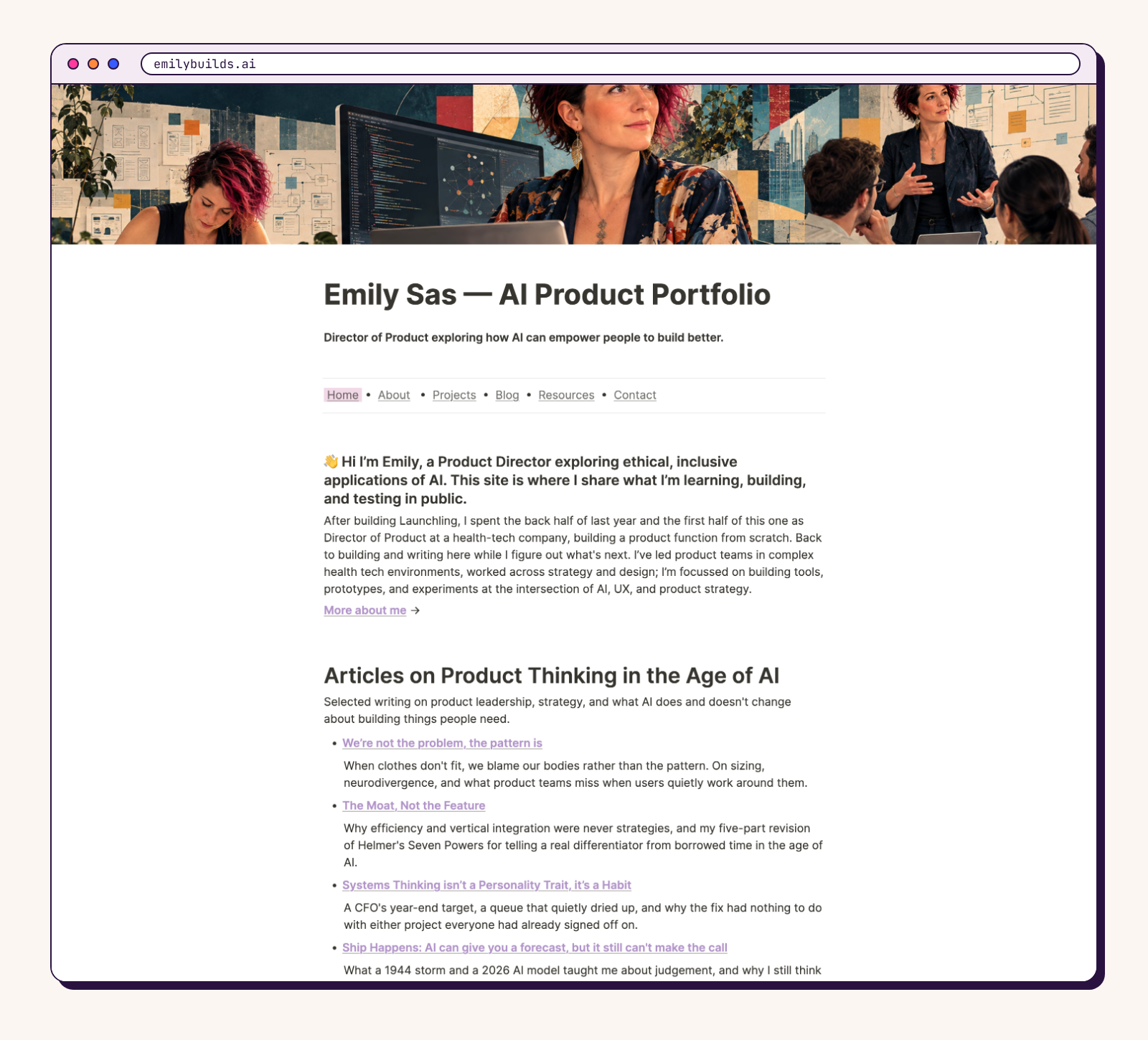
EXP-001● RetiredProductionRan in production as my public site from July 2025 to November 2026. It stopped there because building the site became one of the experiments, and owning the code became cheaper than working around the tools.▸ Under the hood
Deciding not to build: when no-code is the right call, and when it stops being one
In July 2025 I put emilybuilds.ai, the earlier version of this lab, on Notion and Super.so for $26 (about £19) a month, so that I was publishing within days and kept my time for exploring AI tooling. The complexity didn't disappear, it moved somewhere I had less control over; here's why it was still the right call, and why it stopped being one in 2026.
Building the site became one of the experiments, and with a coding agent, owning the code no longer competes with the writing. The rebuilt lab replaced it in November 2026.
Under the hood
Timeline. I registered the domain on 6 July 2025 and the site was live on 9 July. The sign-up form was in place by 9 July: I spent several hours failing to get its welcome email to send and paused it, and it worked from 9 July with help from Namecheap support. The site was retired in November 2026, when the rebuilt lab replaced it.
Stack
Notion for writing and organising every page
Super.so to publish the Notion pages on my own domain, with page addresses, design settings, navigation and analytics, all in its $26-a-month plan
Namecheap for the domains (emilybuilds.ai and emilysas.com) and DNS
Google Analytics for traffic
Tally, Zapier and Airtable for sign-ups: Tally collected names and emails, Zapier passed them to Airtable and sent the welcome email through Namecheap's email service
In July 2025 I published emilybuilds.ai, the earlier version of this lab, on Notion and Super.so rather than coding it myself, because a coded site would have taken time I wanted for exploring AI tooling. I was in the middle of building Launchling, and what I needed was somewhere to write about what I was learning, quickly, without every post becoming a deployment. I asked ChatGPT for options, which included Framer, and picked Notion for the writing (I already used it) and Super.so to turn it into a website, with analytics included in its plan. I accepted $26 a month (about £19) as the price of not maintaining a front end, knowing I might replace it with a coded site one day; it was a trade-off, not an architecture.
emilybuilds.ai on Notion and Super, July 2025 to November 2026
What happened
I registered emilybuilds.ai on 6 July 2025 and the site was live on 9 July, after about two hours' work, the longest part of it fixing navigation and hidden pages. Three problems are worth recording, because none of them was about code:
The domain. Connecting it meant editing the DNS settings on Namecheap, and the changes took long enough to spread that I panicked something was broken.
Links. Links between pages worked best written by hand as absolute links with page addresses, which Notion kept trying to overwrite.
Subpage links. Notion's links to subpages showed at the bottom of pages on the public site; deleting the subpages would have deleted the pages, so I hid the links with a Super setting.
None of them was hard on its own, but together they showed me that I was treating Notion as a content system and Super as an independent presentation layer, when in practice the structure of my Notion pages kept leaking through into the website; when something looked wrong, the first job was working out which of the two tools was responsible. No-code meant I didn't have to write the implementation, but it didn't excuse me from understanding the system; it moved the complexity to places I had less control over.
Browsing was the other limit, because the public site grouped posts by project, with a chronological list underneath, whereas this lab links builds, notes, tools and dates however I choose.
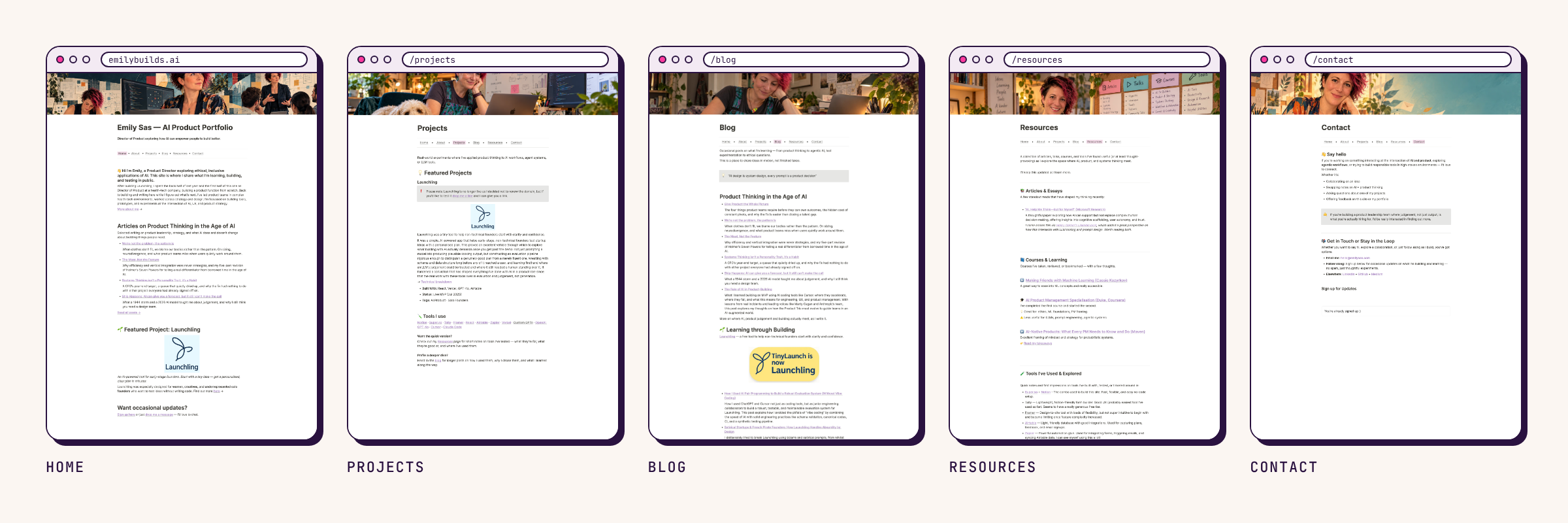
Home, Projects, Blog, Resources and Contact, each under the same banner
I also spent several hours failing to send email from my own domain before Namecheap's support team pointed me to part of the fix, which I wrote up at the time.
Was it the right call?
I think so, and I'd make the same decision with the same goal. I wanted to start publishing, and I was publishing within days rather than fussing with styling and layout; the writing I did on that site in 2025 mattered far more than its implementation. Deciding not to build is a skill I value more as building gets easier, not less.
Why I've rebuilt it now
When I launched it I wrote that "when I get tired of paying Super £16/month (ouch!), I'll code it up properly", though my invoices show the plan was $26 a month. What changed wasn't only the tools. In 2025 the question was how to get my work into the world without spending my time on a website; in 2026 the site is still where I show what I build and how, but building it is now one of the experiments too. The economics have shifted too: with a Claude agent in the Claude app I built emilysas.com, content system included, in about 42 hours elapsed from first commit to final launch change, so owning the code no longer competes with the writing in the way it would have then. This version runs on Astro with Keystatic, which keeps what I liked about Notion (writing without touching code) while separating the content from how it's presented, which was the thing I kept fighting in Super. Adding anything to the lab, whether a build, a note, a stack entry, a timeline event or a skill, is a form in Keystatic's editor, and the new item slots straight into the site's design with no layout work from me. I've written up how the new lab was built.
If you're weighing whether to build something yourself or buy a tool that gets you there sooner, I'd be glad to compare notes. Get in touch.
Then / Now
Aspect
2025
2026
Goal
Show the work, and start publishing quickly
Show the work, and make the site an experiment in itself
Build cost
A coded site would have taken time I wanted for exploring AI tooling
emilysas.com took about 42 hours elapsed, first commit to final launch change, with a Claude agent
Content and presentation
Notion's page structure leaked into the site
Content model defined once; presentation entirely separate
Browsing
Grouped by project, with a list by date
Builds, notes, tools and dates linked however I choose
Running cost
Super's plan, analytics included, $26 (about £19) a month
Netlify's Personal plan, $9 (about £7) a month
What I had to understand
Two platforms' interaction, with limited visibility
Code I own, which I can read, test and change
Who did what
I framed
The problem: I needed somewhere to write about what I was learning, quickly, without every post becoming a deployment
The constraint: the site mustn't take time I should be using to explore AI tooling
Notion for writing and Super.so for publishing, over a coded site or the other options ChatGPT suggested
$26 (about £19) a month as the price of not maintaining a front end, knowing I might code it later
Writing absolute links with page addresses, and not letting Notion overwrite them
Hiding Notion's child-page links with a Super setting, which I found myself
Grouping posts by project with a chronological list
Pausing the welcome email rather than leaving a broken one live
Finding each sign-up in Airtable by email address instead of a fixed record ID
Rebuilding the site in code in 2026, as one of the experiments
ChatGPT suggested
Tools to consider, Framer among them, before I chose Notion and Super.so
Troubleshooting steps while I set the site up. One was wrong: it said Notion subpages could simply be deleted, but deleting one deletes the page, so I hid them with a Super setting instead
The team
Agents and models
Name
Role
Model
What it was for
ChatGPT
Other
ChatGPT
Suggesting tools (Framer among them) and troubleshooting steps; one answer, that Notion subpages could simply be deleted, was wrong
People
Me Chose the tools, set up and ran the site, wrote the posts
Namecheap support Told me which password to use, one of the two fixes that made the welcome email work
Constraints and unblocking
$26 (about £19) a month for Super, accepted as the price of not maintaining a front end
Time: the site couldn't take hours away from exploring AI tooling
Registered emilybuilds.ai and emilysas.com on Namecheap, and pointed emilybuilds.ai's DNS at Super
Unblocked the welcome email by asking Namecheap support
Tools
Notion Writing and organising every page
Super.so Publishing the Notion pages on my domain, with analytics in the same plan
Namecheap Domains, DNS and the email account the welcome email came from
Google Analytics Traffic
Tally, Zapier and Airtable The sign-up form, and recording who had been sent the welcome email
Ledger
Item
Value
Basis
Note
Time to get the site live
About two hours
Estimated
Worked. My estimate at the time, in the 2025 post.
Domain to launch
Three days
Measured
Elapsed. Domain registered 6 July 2025; live 9 July.
Failing to get the welcome email to send
Several hours
Estimated
Worked, before I paused it. My own description at the time; it worked from 9 July 2025, after two fixes, one from Namecheap support.
Running cost
$26 (about £19) a month for Super
Measured
My own billing, every invoice checked: $26 a month, analytics included, from July 2025 to my most recent invoice, on 6 October 2026. I've since moved to the $16 plan without analytics, so the renewal on 6 November 2026 is $16 for any final month before the site is deleted. The sterling figure uses HMRC's rate for July 2025, the month the site went live. Domains are excluded here and from the 2026 figure.
Measured
counted or timed directly
Modelled
estimated from a stated method
Upper bound
the most it could be
Estimated
my own estimate, not measured
Time figures say whether they are elapsed or worked. Time between commits is never presented as hours worked.
Non-sterling costs show the amount paid, with an approximate sterling figure at that month's average rate. Rates from HMRC's monthly exchange rates.
Outside the lab
What this would take in an organisation.
In an organisation, this is the build-or-buy decision, and the lesson is that buying a platform doesn't buy you out of understanding the system. Someone still has to know how the pieces interact, because when something looks wrong the first job is working out which tool is responsible, and the vendor's way of structuring things leaks into what customers see. That's often the right trade when getting to market matters more than control. It stays the right trade only if the team names it as one, and agrees in advance what would make them revisit it: a price, something the tool won't do, or a change in what the product is for.