
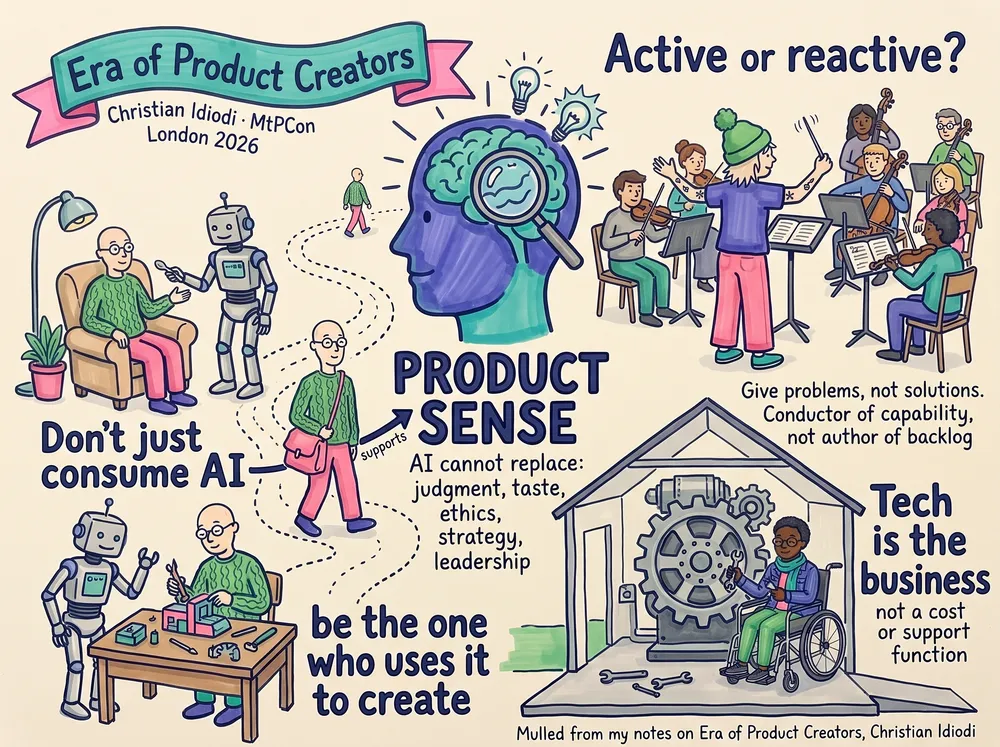
Update, 3 November 2026. The first real test changed my mind about what Mullo is for. I made a sketch note from my takeaways from a talk, and compared it with two from NotebookLM: one made from the transcript alone, and one from a careful prompt containing my five takeaways. Mullo's page was the one I'd want to keep, in my judgement, but given my takeaways, NotebookLM reproduced five of the nine pieces of text I'd asked for exactly, alongside many additions of its own, so choosing your own takeaways isn't what makes Mullo different. Getting to Mullo's page also took far more effort, through a long form, two approvals and strict checks that forced rerun after rerun. I'm now redesigning the journey around a short quiz, where Mullo drafts everything and I react, choose and add, with one check on meaning in place of the exact-word and arrow checks. Until the redesign lands, the sections below describe the version I tested.
What Mullo does
I go to a few talks and courses a year and take plenty of notes, then rarely look at them again. In the version I tested, Mullo started from the part that matters to me: I wrote down what stuck, in my own words, before any model saw the notes, and only then did it plan and draw a page. In the redesign, that's an optional "Before we peek" card, for transcripts as well as notes. A language model turns my notes and chosen takeaways into a plan for the page and its small scenes, an image model draws the whole page, words included, and a checker reads the result against that plan. I approved the page's words before it was drawn; in the redesign, that approval moves to before sharing. Every page carries the line "Mulled from my notes on…", crediting the speaker.
Asking before building
I had Perplexity research AI visual note-taking over four rounds, deliberately without telling it who Mullo was for, so its findings were free to contradict me. Each round went to a builder team of four Claude personas, a product manager, a CTO, a UX lead and an evals lead, whose job was to argue over what it meant and change the plan only where they agreed. The evidence was thin, mostly posts on Reddit, LinkedIn and Substack, and we treated it that way, checking what we could and catching Perplexity misattributing a journal.
It still changed more than any design session did:
- Sharing depends on where the notes came from. Public talks can be shared. Paid courses and conferences with delegate terms default to a private study copy, and Chatham House sessions get anonymised themes only.
- The page leads with my words. Speaker tagging is opt-in, and only once the page has passed its check.
- It's a portfolio build, not a venture. People attend a few events a year, rarely pay for tools like this, and the big platforms could add it in a release, so I'm building Mullo to learn from rather than to sell.
The fourth round led my builder team to drop the hand-drawn look, because that look had become shorthand for AI slop. When I saw the result, I overruled it: without the drawings the page was just a diagram, and what separates a Mullo page from slop isn't its look but its words, which are mine and are checked against a plan made from my notes.
Two ways to draw a page
The first trial compared two routes on the same notes. In route A, the model drew only the pictures and code set every word, so the words were exact by construction; on every run from real notes, though, text overflowed its box. In route B, the model drew the whole page, words included, and the checker read every word and arrow, with up to three attempts to repair it. Route B looked like a page someone had made, and I chose it; in my notes from the session, "I really only like Route B".
Two findings surprised me. The larger image model, Nano Banana Pro, wasn't clearly better, and cost about twice as much; on the same notes and prompts, its first attempts drew 7, 8, 7 and 1 arrow errors across four runs, against 0 to 5 for Nano Banana 2.1. The prompt mattered more than the model: four rounds of prompt changes took the drawing from rejected to a page I accepted. The source mattered too, with short course points coming out clean far more often than dense talk notes.
Checking every word and arrow
This describes the checks I tested up to 3 November. They didn't work well enough, and the redesign replaces them with a different set.
The errors were rarely ugly; they were plausible. Duplicated words ("solving solving"), invented filler ("AI worf product disrilers it?") and punctuation silently changed were all common, but the most common fault was an arrow linking two ideas my notes never linked. On a sketch note, an arrow says one idea leads to another, so at first I treated an invented arrow as a claim put in my mouth. I've since changed my mind: an arrow within one idea is a pointer rather than a claim, and checking arrows and exact wording this strictly drove reruns while missing the slips in meaning that mattered: two shortened captions changed what I'd written, and both passed.
The verifier, Gemini 3.8 Flash, checks each word against the plan and each arrow's ends, direction and label. While building it, I used 21 errors planted on purpose, written by Claude and by Gemini, so a Claude-built checker wasn't graded only on errors Claude had imagined; a case counted only if all three reads caught it. It caught all 21, but those were the cases it was tuned on, so they're a development result rather than proof it can be trusted. The best of three later, larger runs missed 3 of 35 planted errors, against a limit of 2, with 11% false alarms. The test it wasn't tuned on is a hold-out set, made from my notes on Making Friends with Machine Learning, kept aside and scored only at milestones; it was never scored before I changed approach. It can block a sketch note but never approve one; nothing is shared until I've looked at it and chosen to. A separate test fed the planning step six sets of notes with instructions hidden inside, and it obeyed none of them.
What the checks couldn't see
A checker built for words and arrows passes a person with three arms. A body check added later, for under a penny a page, caught the arms but still missed a head drawn on backwards.
The bigger blind spot was the people. When I asked for more diverse people on the pages, the AI writing the scene descriptions met the request by attaching an identity to each scene, and gave out the roles along stereotyped lines; the image model drew exactly what it was told, so every check passed. I've written that up separately, in Diverse by prompt, biased by role.
Casting decided by code
The fix changes who decides:
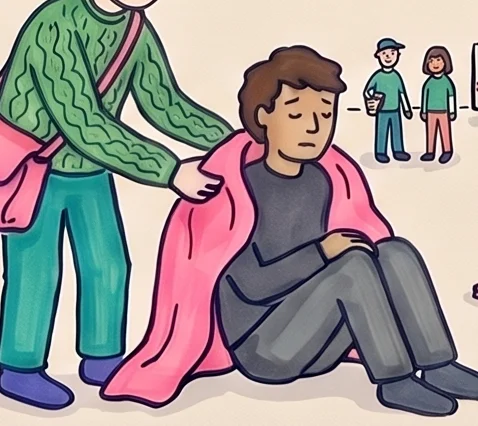
- The step that plans the scenes never says who anyone is. It describes each task and how it's done with dignity: upright, with the right tools, competence visible.
- Code fills the roles from a recurring cast of 14 people, choosing the least-used first, and never puts anyone with a mobility aid on uneven ground.
- The check reads people by a marker, never by identity, such as a teal scarf or a yellow beanie, and blocks a page where the wrong person holds a role or a step-free scene has steps. A separate read of the whole picture can only raise concerns, never pass a page.
The six v0.10 runs with the new casting showed that the checks now see what earlier versions couldn't: an engineer drawn small at the edge of the work, other people doing the marked characters' tasks, one character drawn three times, and a plank that didn't reach the far bank, which a later prompt fixed. One of those pages was clean on words and arrows. The casting is far from solved, but the failures are now visible, which is where fixing them starts.
Against NotebookLM
The first real test, on 3 November, set Mullo against a general-purpose tool on the same talk. I made two Mullo pages, one before fixes and one after, and two sketch-note infographics in NotebookLM: one from the transcript alone, and one from a careful prompt containing my five takeaways, a title, one requested arrow and an instruction not to draw real people. Claude Code, which builds Mullo, then scored the pages.
The scores, all measured:
- Mullo, before fixes: 25 of 27 short phrases exact, with 3 added.
- Mullo, after fixes: 26 of 27 as scored; the one miss was the scorer's own misreading.
- NotebookLM, from my prompt: 5 of 9 exact, with 24 added, and it drew the one requested arrow correctly. Both Mullo pages missed that arrow; on the fixed page its label sat inside a drawing, attached to nothing.
Neither side was clean. NotebookLM wrote "fall" where my takeaway said "fail", which changes the meaning, and nothing flagged it. Mullo's own checks passed two errors of meaning: a word that changed what I'd written, and a dropped hedge. The first came in at the planning step, not the drawing, so the lesson is to check proposed wording against my takeaway when it's proposed. Both are now planted test cases. The scorer was flawed too: it misread one phrase, it wasn't like for like, scoring Mullo on 27 short phrases and NotebookLM on 9 pieces of text, some of them whole paragraphs, and it checks that words are present, not what they mean, so neither meaning error showed up in its counts.
The main finding is the uncomfortable one. With my takeaways in the prompt, NotebookLM reproduced five of the nine pieces of text I'd asked for exactly, alongside many additions of its own, and since the scores don't compare directly, text accuracy alone doesn't separate the two. Mullo's case rests elsewhere: there's no prompt to write; once the redesign's check on meaning is built, slips like the two above should be caught before I see a page; it can repair one part of a page instead of redrawing it, which worked on the first Mullo page here; and it gives a library of pages a consistent look. Only the repair was tested in this comparison.
The effort was the other half. Before anything was drawn, Mullo's journey had me review every name in the transcript one by one, decide on four "not found" cards with a typed reason each, fill in a plan form with words, a drawing idea and a setting for every idea and a part for every person, and approve the page twice, with a wait in between; NotebookLM needed one prompt. That Mullo's page was the best of the four is my judgement, from one talk.
Own goals
The builder broke its own rules twice, and I'd rather record that than tidy it away. Claude Code hard-coded a £0.20 approval that went around the gate it had just built for paid runs. A broad git add -A swept my edits to the product spec into one of its commits.
Style
At first I couldn't see any difference between pages drawn with my own doodles as style references and pages drawn without them. A few prompt rounds later, the influence is clear in the illustrations.
What's next
Five milestones are done: the trial that settled the route, the app's notes and recall, the plan, which checks my takeaways against my notes, suggests ideas I missed and picks the cast, the drawing, which is now in the app, with a preview, an overlay and fixing one part of a page at a time, and the faithfulness gate. My first two pages from a real transcript were both blocked after three tries, at £0.64 and £0.68; in my notes, "the second try was a strong sketchnote". The gate has 44 test cases I approved and has had three evaluation runs: the best missed 3 of 35 planted errors, against a limit of 2, with 11% false alarms, so it isn't good enough yet. Reflection arrows are no longer blocked, since the checker now reads whether a line is dotted or solid and arrows no longer block a page at all.
Next is the redesign described at the top: a short quiz, a page Mullo drafts for me to react to, one check on meaning, and casting the user never has to think about. After that come export and sharing, and a hosted version behind a password, with a public replay. Still to come is a test with speakers: shown a Mullo page and a NotebookLM infographic of their own talk, without being told which is which, which would they reshare?