EXP-005● BuildingPilotUsed by three family households, lightly so far. Opening it to friends' households needs the open security and privacy findings fixed, backups running, and accounts tried on a real database; production needs evidence that outsiders will add their own books, and paid plans that stop it ever losing money.▸ Request an invite▸ Under the hood
Cheap to build, hard to stop: when AI builds faster than you can learn
Fold is a recipe app for vegetarian households with a vegan at the table, built with one AI session writing specs and another writing code. I built it for my own family's needs, so its first features needed no outside evidence; once I began to see its wider potential, I added a fair amount of complexity without checking whether it was warranted, which is the risk of building as fast as AI allows. Here's what that cost, what broke, and the rule that now makes every new piece of work name the assumption it tests.
Can one person with two AI sessions build a product for real households at full speed, and keep it safe, affordable and honest about what it knows?
Started
Oct 2026
Status
Building
Readiness
Pilot
Tools
Claude Code · React + Vite · Vercel · GitHub Actions · the stack
Under the hood
Timeline. First commit on 15 October 2026 and the first tagged release (v1.0.0) on 18 October, then a quiet stretch from 19 to 23 October. Ten releases by v1.9.0 on 29 October. The reverse PRD, strategy and decision log were written on 29 October, and the review panel started work the same day. Allergy profiles were removed on 30 October. Still building: an invite-only beta, starting with friends' households, is being prepared.
Stack
App: a React progressive web app (Vite, React 19, TypeScript) that works offline, on Vercel's free plan
Data today: private repositories and a hosted database
Data next: a hosted Postgres database in the UK, with per-household access rules and sign-in by emailed code; built and tested against stand-ins, not yet switched on
Models Fold calls (as of October 2026): Claude Opus 5.5 reads recipe photos, links and pasted text; Claude Haiku 5.5 reads book covers and checks every drawing; Google's Nano Banana 2.1 draws dishes and technique steps
Spend guards: a per-household allowance and a daily cap on Claude calls, which fails closed
Checks: a validator and a matching save check, unit, data and layout tests, and six review agents (Fold's review panel)
Built by: a Claude chat session writing specs as UPDATE files, and a Claude Code session building, in one repository
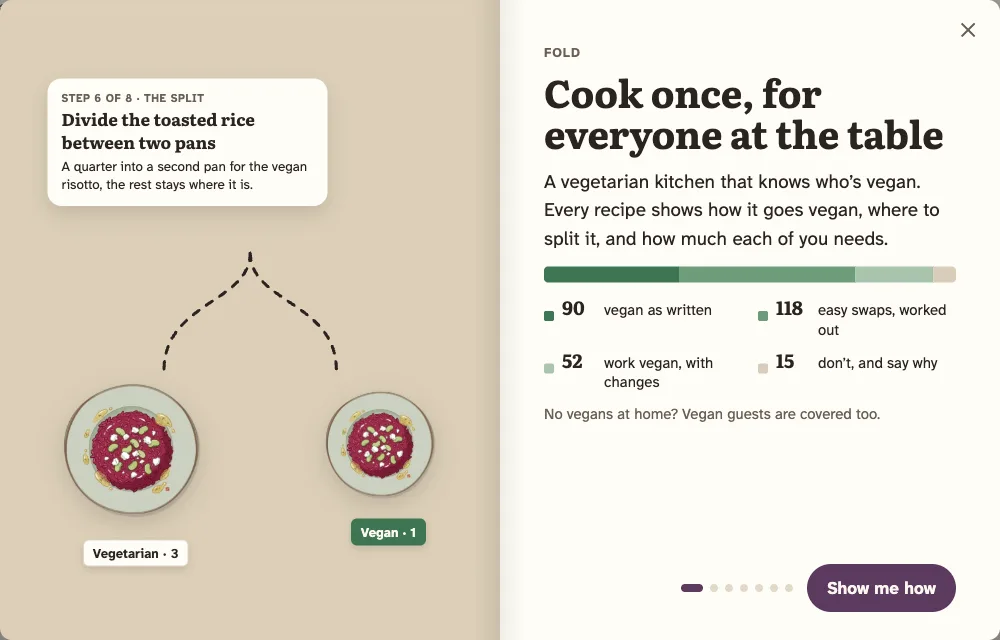
Fold started as decluttering. I wanted one master copy of the recipes I actually cook from my cookbooks, readable on an iPad and printable, in a form that suits a household where not everyone eats the same. Nothing I could buy did that, so I built it. It has become something more specific: a vegetarian kitchen that knows who's vegan, shows how each recipe could be made vegan where possible, where to split it into two pans, and how much each person needs. It's deliberately not "for vegans"; it's for the mixed table.
How Fold works: one recipe, split where it goes vegan. November 2026.
How it's built
Two Claude sessions share one folder. A chat session handles product, design, specs and research, and writes each piece of work as an UPDATE file straight into the repo (84 by 1 November). Claude Code does the engineering, branches, tests and merges, and sends REQUEST files back when it needs a decision. I coordinate and own the decisions. Small fixes take a fast lane, where CI merges them when checks pass, "so fixes ship even when Emily is out of credits"; features take a gated lane, and anything that changes stored data waits for me.
At its peak, 181 commits reached the main branch in a single day (28 October). No person could review that line by line, which is why Fold has a review panel.
Never loss-making
The rule: no free action triggers inference, and every AI cost is prepaid by the household that causes it, under a hard global ceiling. I wrote it down as a rule on 29 October, but the guards came first: a per-household allowance from 17 October (now 60 recipe reads to start, then 20 a calendar month), and from 24 October a global daily cap on Claude calls, taken atomically so parallel requests can't both slip past. If the cap can't be counted, nothing is called. The family and the friends' beta are subsidised by me; the rule applies from the first public release. October's bills came to about £72, most of it one-off setup (the ledger). The honest caveat: Fold's own cost log is calculated per call from a price table, and hasn't yet been reconciled with those bills.
What I got wrong
I added complexity without checking it was warranted. Fold began with my own family's needs, so its first features needed no outside evidence. Once I began to see its wider potential, the nice-to-haves went in as well, because at the speed AI builds nothing forced me to descope them; I think that's the real risk of building this fast. Allergies are the clearest example: Fold collected allergy profiles and used them to hide a recipe or show a warning on it, which seemed like a good idea at the time, but I hadn't realised the risks, including legal risks, and I removed allergy profiles on 30 October (decision 10). The Know-how section of technique guides is another; it's a nice-to-have rather than core to the app, but it has been very complex to build well, especially the illustrations. The next point is how I found out.
The problem statement was never written down whole. I had three partial records of it: decluttering (15 October), cooking mid-flow (16 October) and "cook once, for everyone" (28 October). After about 700 commits in a fortnight, my AI builder team and I wrote a reverse PRD, reconstructing the intent from what had been built. It read those three records as two pivots, which they weren't: it was always one problem, and I've now recorded it whole. More usefully, it found there were no success or stop rules for the beta at all. The response is now a house rule: every new piece of work names the assumption it tests, or it goes to the backlog.
I broke my own staging rule. The spec said paid photo-to-recipe should wait for evidence from cheaper stages; it was built on day two.
Free tiers ran out. I won't pay for GitHub or Vercel, so they're hard limits rather than bills. October used 2,163 Actions minutes against 2,000 free, 2,162 of them on CI, and runs stopped on 26 October, and Vercel's 100 deploys a day ran out on 28 October, so nothing could go live for a day. Those limits changed how Fold is built more than the money did: deploys are rationed, docs ride with code, and CI only runs what a change needs.
A check failed open. For two days the save check crashed and reported "no errors" for every save, and invalid data reached the main branch. Now a crash means "couldn't be checked".
First use is hard. Three family testers were overwhelmed or missed key features, which is evidence against one of my riskiest assumptions.
The scheduler toasted risotto rice 49 minutes early, because nothing in the data said it couldn't wait.
The riskiest assumptions, and where they stand
The reverse PRD mapped sixteen assumptions and ranked them by risk and uncertainty. The scores are judgement, not measurement, and they're there to order cheap tests rather than to justify building anything. These matter most:
Assumption
Where it stands
New households will add their own books, unaided
The riskiest. Untested: no household outside my family has used Fold yet
The mixed-table problem is real and frequent
Assumed. A survey and five conversations are planned
There are enough mixed households who cook from books to sustain a small product
Assumed. A rough bracket is 150,000 to 250,000 UK households, before narrowing to those who cook from books and would pay
First-timers can learn Fold
Evidenced against: three family testers were overwhelmed or missed key features. The fix is untested with a new user
AI reads need only a light check
Unproven. There's no reference set yet, and the save check once failed silently for two days
One person with two AI sessions can keep this pace safely
Evidenced, but strained: CI stopped, there were no backups, and the deploy limit was hit
AI reads are safe enough to hide recipes from someone with an allergy
Removed rather than tested: Fold no longer holds allergy data about anyone (decision 10)
Forecasts ("ready at 19:30") are accurate enough to trust
Waiting for the beta: the family's logs are too thin to say
No claim on this page rests on measured usage yet.
Research before outsiders
Before any household outside my family used Fold, I ran nine Perplexity prompts as desk research, ending with one that tried to prove there was no market. It sharpened the audience (cooks with big cookbook libraries are why people would start; the mixed table is why they'd stay) and the pricing (pay upfront for a first batch, so the expensive part is prepaid). What it couldn't tell me is how many households like mine exist, so a two-part survey is next, with its thresholds agreed before any results arrive.
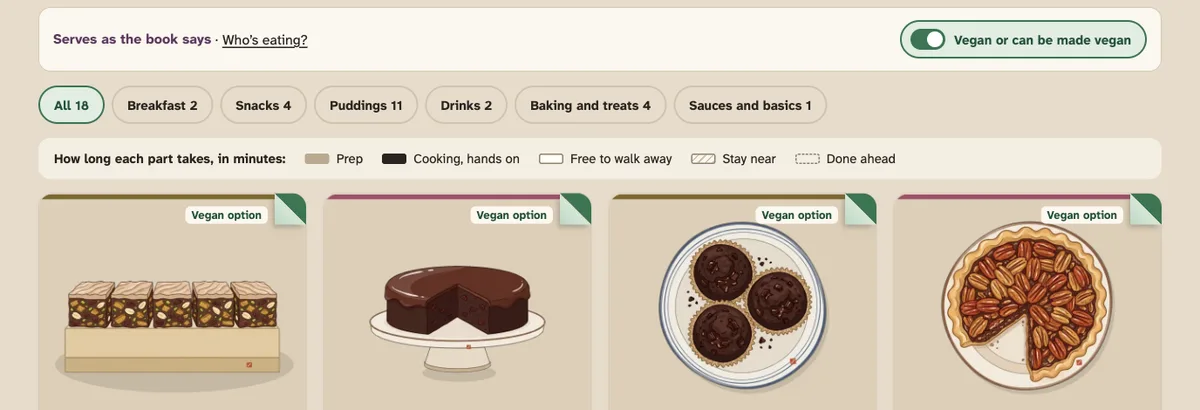
One of the household's cookbooks in Fold, every recipe drawn in the same style.
What's next
An invite-only beta, starting with friends' households and open to anyone who cooks for mixed diets and will tell me how it goes, at fold.emilybuilds.ai, once its safeguards are in place. Three are done: allergy profiles are gone (decision 10), the review panel is merged, with all six reviewers now run (the cost and recipe reviewers for the first time on 1 November), and CI runs on Fold again. The rest aren't yet. The reviews of the beta's accounts work found 13 security issues and 15 privacy issues. The one Critical is moot now that allergy profiles are gone; the rest are waiting for my decisions. The nightly backup isn't set up yet (it failed all three of its recent runs), and I'm setting it up next. The accounts also need trying against a real database rather than stand-ins, and before any household outside my family adds a book, I want a legal view on copyright.
If you're building fast with AI and trying to keep the evidence in step, I'd be glad to compare notes. Get in touch.
Then / Now
Aspect
When it bit, October 2026
By 1 November 2026
GitHub Actions minutes
CI ran in full on every push: 376 runs used up October's free minutes by 26 October, and after that only local checks stood between a change and main
Data and docs changes skip the code steps, superseded runs are cancelled, and layout tests run only when they're relevant, aiming to average under an hour a day
Vercel deploys
Every push to main deployed, testers' saves included, and the 100 a day ran out on 28 October
Only main and preview branches deploy; docs ride with the code they describe; branches are pushed when ready, not after every commit
My Claude usage
Often ran out mid-session, with testers using Fold
Small increments that are always shippable, handoff notes after each one, and reviews run at the depth a change needs
A check that failed open
For two days the save check crashed and reported "no errors" for every save
A crash means "couldn't be checked", and the build runs the validator first, so an error on main stops the deploy
Knowing what it's for
Three partial records of the problem, and no success or stop rule for the beta
The problem recorded whole, a ranked assumption map, and every new piece of work naming the assumption it tests
Who did what
I framed
The problem: one usable copy of the recipes we actually cook, for a household where not everyone eats the same
The ambition: a portfolio build exploring whether Fold can become a small business, on condition that it never loses money
The constraints: free tiers only for GitHub and Vercel, and no household outside the family until the safeguards are in
The team: a chat session writing specs and a Claude Code session building, passing UPDATE and REQUEST files between them
A per-household allowance on recipe reads, and a daily cap on paid calls that fails closed
Rationing deploys, with only main and preview branches deploying
Reading recipes from photos with a paid model on day two, ahead of my own staging rule
The reverse PRD, written with my AI builder team: what Fold is for, reconstructed from what had actually been built
I set up the team
1 reviewer · 1 builder session · 2 planning sessions · 3 models in the product · 2 people · 8 standing rules · 7 constraints
The problem never pivoted: the three dated statements were partial records of one problem, so I corrected the reverse PRD
Two lanes: small fixes merge once checks pass; features merge once every local check passes, because I review most things in production; changes to stored data wait for me
New work names the assumption it tests, or goes to the backlog
The friends' beta goes through the full database migration, not a thin separate copy
Fold holds no allergy data about anyone; allergens are a label on each recipe
Web-first through the beta and a first launch
Nano Banana 2.1 to draw, after a side-by-side trial
Claude built
Fold itself: 84 UPDATE specs from the chat session; the code, tests, merges and releases from Claude Code
Proposed, and I approved: allergen labels that say who checked them
Proposed, and I approved: "Too late" only for a planned meal
Proposed, and I approved: grouping the queued work into one release
The team
Agents and models
Name
Role
Model
What it was for
Chat session
Plans
Claude Opus 5.5
Product, design, specs and research; writes each piece of work as an UPDATE file in the repository (84 by 1 November)
Builder team
Plans
Claude Opus 5.5
Wrote the reverse PRD and assumption map with me, as a product team in one chat (UX lead, CTO and product voices)
Claude Code
Builds
Claude Opus 5.5
Engineering: branches, tests, merges and releases; sends REQUEST files back when it needs a decision (13 so far)
Review panel (six agents)
Reviews
Claude Opus for security and privacy; Claude Sonnet for the other four
Independent checks from a fresh context, called for the changes that need them; see Fold's review panel
Recipe reader
In the product
Claude Opus 5.5
Reads cookbook photos, links and pasted text into recipes; the most expensive tier, kept until a reference set shows a cheaper model is as accurate
Checker
In the product
Claude Haiku 5.5
Reads book covers, and checks each drawing against the recipe
Illustrator
In the product
Gemini Nano Banana 2.1
Draws dishes and technique steps from written notes, never from the book's photograph; won a side-by-side trial at about half the price
People
Me Product owner: set the problem and the constraints, coordinated both sessions, made the calls
Family testers Three family households with access to Fold; their feedback and their thin usage logs are the only usage evidence so far
Standing rules
Small increments, always shippable, with handoff notes after each, so work survives my usage running out
main is production: every piece of work on its own branch and pull request
Changes to stored data are tested against a copy of the real data, must be reversible, and wait for me
Every paid call counts against a daily cap, and recipe reads against an allowance too; if the cap can't be counted, nothing is called
Deploys are rationed: docs ride with code, and branches are pushed when ready
New work names the assumption it tests, or goes to the backlog
Decisions are logged with their reason and what would reverse them
Commits cite the spec or brief behind them
Constraints and unblocking
GitHub Actions: 2,000 free minutes a month. October's ran out on 26 October, and I won't pay for more
Vercel's free plan: 100 deploys a day. They ran out on 28 October
My Claude plan (Max 5x), whose usage often runs out mid-session
Inference I pay for: £32.67 for Gemini and $52.79 for Anthropic in October, mostly one-off setup. Gemini's image models had no free tier as of November 2026, and a standard budget alert only warns
Fold's own limits: 60 recipe reads per household to start, then 20 a calendar month, and a daily cap on Claude calls across Fold
Unblocked: approved the dish and equipment drawings before they went live, and every proposed recipe-tag change before it was applied
Still mine to do: the accounts database, the email domain and DNS for fold.emilybuilds.ai, and setting up the nightly backup
Reviewers
Me Final say on stored-data changes, drawings, accepted risks and product decisions
Fold's review panel Six fresh-context reviewers for security, privacy, QA, cost, analytics and recipe truth
Tools
Claude Code The building session, working in the repository on branches
Claude chat The planning session, writing UPDATE specs straight into the repository folder
GitHub Private repositories for code, pull requests, and testers' saves
GitHub Actions CI, on the free monthly minutes only
Vercel Hosting and deploys, on the free plan
Perplexity Nine prompts of desk research on the market, ending with the case against
Decision log and handoff files Decisions with reasons and reversal conditions; where the work stands, for the next session
Ledger
Item
Value
Basis
Note
Commits, 15 to 30 Oct
1,073 across all branches: 682 code, 240 merge, 151 data saves (917 on main)
Measured
From git history. My separate logs repository adds 23 (as of 29 October) and is not included.
Releases
Eleven
Measured
Git tags v1.0.0 (18 October) to v1.10.0 (1 November).
Recipe reads
About 10 to 25¢ (about 7 to 19p) each
Modelled
From token counts and a price table, 8 to 12¢ (about 6 to 9p). Fold's first cost audit (1 November) models about 10¢ (about 7p) with the prompt cached and about 25¢ (about 19p) without, and whether the cache hits in use isn't measured yet; one measured spot check, four real reads, came to about $0.77 (about 57p).
Drawings
$0.034 (about 3p) each ($0.017, about 1p, in a batch)
Modelled
The list price in Fold's code as of October 2026, plus a Haiku check of a fraction of a penny. Trials and redraws aren't in it: see the Gemini bill below.
Gemini API, 1–29 Oct (mostly one-off setup)
£32.67
Measured
Billing. About £28 on a single day (~26 Oct), then roughly £1–1.50 a day.
Anthropic API, October (mostly one-off setup)
$52.79 (about £39)
Measured
Billing. Spikes of ~$31 (about £23) on 17 Oct and ~$16 (about £12) on 18 Oct, then under $5 (about £4) a day.
Combined inference, October
about £72
Modelled
The two bills added, with the Anthropic bill at HMRC's monthly rate for October 2026. Gemini covers 1 to 29 October, Anthropic to about 30 October. All of it is Fold.
Hosting, database, email and CI
£0
Measured
As of October 2026.
Per recipe, Anthropic (one-off setup)
under ~$0.20 (about 15p)
Upper bound
A ceiling from the bulk days, not a unit price.
Per recipe, Gemini (one-off setup)
~£0.10
Upper bound
A ceiling from the bulk days, not a unit price.
Active session time, 15 to 30 Oct
about 54 to 89 hours, depending on the cut-off
Modelled
Elapsed. From Fold's Claude Code transcripts, 18 sessions, parallel sessions counted once. 54.3 hours counting gaps under 10 minutes; about 75 at 30 minutes; 89 at 60. Includes Claude working unattended and excludes chat-only work, so this is not hours worked.
My own interaction time
at least 10.2 hours
Modelled
Worked, as a floor: gaps under 10 minutes between my turns, overall, 14 to 31 Oct. Misses reading time.
Turns and messages
328 turns from me; 9,510 assistant messages
Measured
From the same transcripts. Several sessions had no turns from me because another session started them.
Claude plan
Max 5x
Measured
As of October 2026. Plus my Claude subscription, which I use for everything else too. Listed separately, not apportioned.
Claude Code usage (subscription)
Opus about 8.2M output and 4.2bn cache-read tokens; Sonnet about 0.16M output
Measured
Covered by the subscription, not billed per token, so it is not money spent. Separate from the measured API bills above.
Measured
counted or timed directly
Modelled
estimated from a stated method
Upper bound
the most it could be
Estimated
my own estimate, not measured
Time figures say whether they are elapsed or worked. Time between commits is never presented as hours worked.
Non-sterling costs show the amount paid, with an approximate sterling figure at that month's average rate. Rates from HMRC's monthly exchange rates.
Outside the lab
What this would take in an organisation.
When building gets cheap, the scarce thing in an organisation stops being engineering capacity and becomes the discipline to stop. Fold''s first features served my own family, so they needed no outside evidence; the trouble started when I saw its wider potential and added a fair amount of complexity without checking whether it was warranted. When AI builds this fast, nothing forces you to descope the nice-to-haves, and I think that''s how escalation of commitment now arrives, at machine speed. What worked here would work in a team. Write the problem down whole before the backlog grows, make every new piece of work name the assumption it tests, and agree in advance what result would make you stop. Hard limits helped as much as rules did: free quotas that stop the service rather than bill it changed how Fold is built more than the money did, and a cost rule written before launch is easier to keep than one retrofitted after the first bill. In an AI product team I'd want an assumption map that gets read rather than filed, and a named person who owns the decision to stop.