Note
A recipe for honest pictures: how to avoid AI image slop without copyright trouble
People choose what to cook by picturing it, but cookbook photos aren't mine to reuse, and AI pictures of dishes nobody has cooked are usually wrong. Here's how separating looking from drawing gave every recipe in Fold a picture that's true to the dish without copying anyone's.
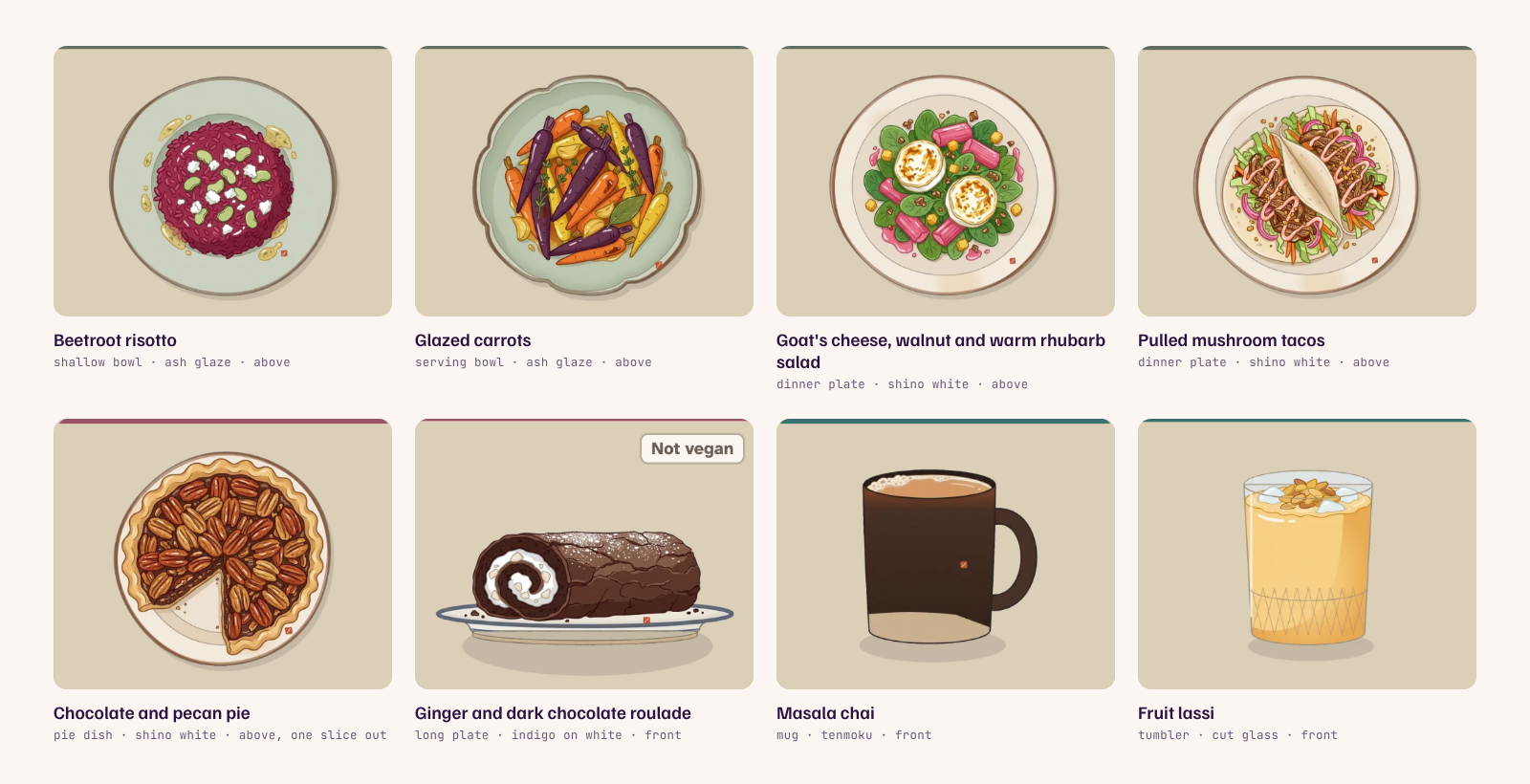
The problem
My recipe app, Fold, was starting to take shape, but faced a problem I knew needed solving and had also been raised by my testers: people choose what to cook by picturing it, and my app had no pictures. A list of recipe titles is hard to browse. Some of my recipes come from books with a photo of the dish, but in a lot of cases I'd cropped the photo out of my picture of the page, because I didn't think I could use it. Fold lets a household add recipes from books they own, for their own use, but that permission covers the recipe, not the photographer's picture. That means the photographs can't be stored, shown or reused, and without them every card would be a title and some text.
Three possible answers, and why none of them works
Allow people to upload their own photos. This was my first thought, but I realised it didn't actually solve the problem as it would only take place if they'd already selected the recipe and cooked it, whereas without images there's a good chance people simply won't select the recipe in the first place.
Generate a picture from the recipe alone. An image model given only a list of ingredients and a method produces something plausible and often wrong: the wrong colour, the wrong shape, a garnish the dish never has. For a cook choosing dinner, a picture that doesn't resemble what they'll make is worse than none. It lets them down at the moment they cook it, and it makes the whole product look careless.
Ask the model to redraw the book's photograph in a house style. The picture would be accurate, but it would still be a copy of someone else's photograph, just in a different style.
The answer: taking notes
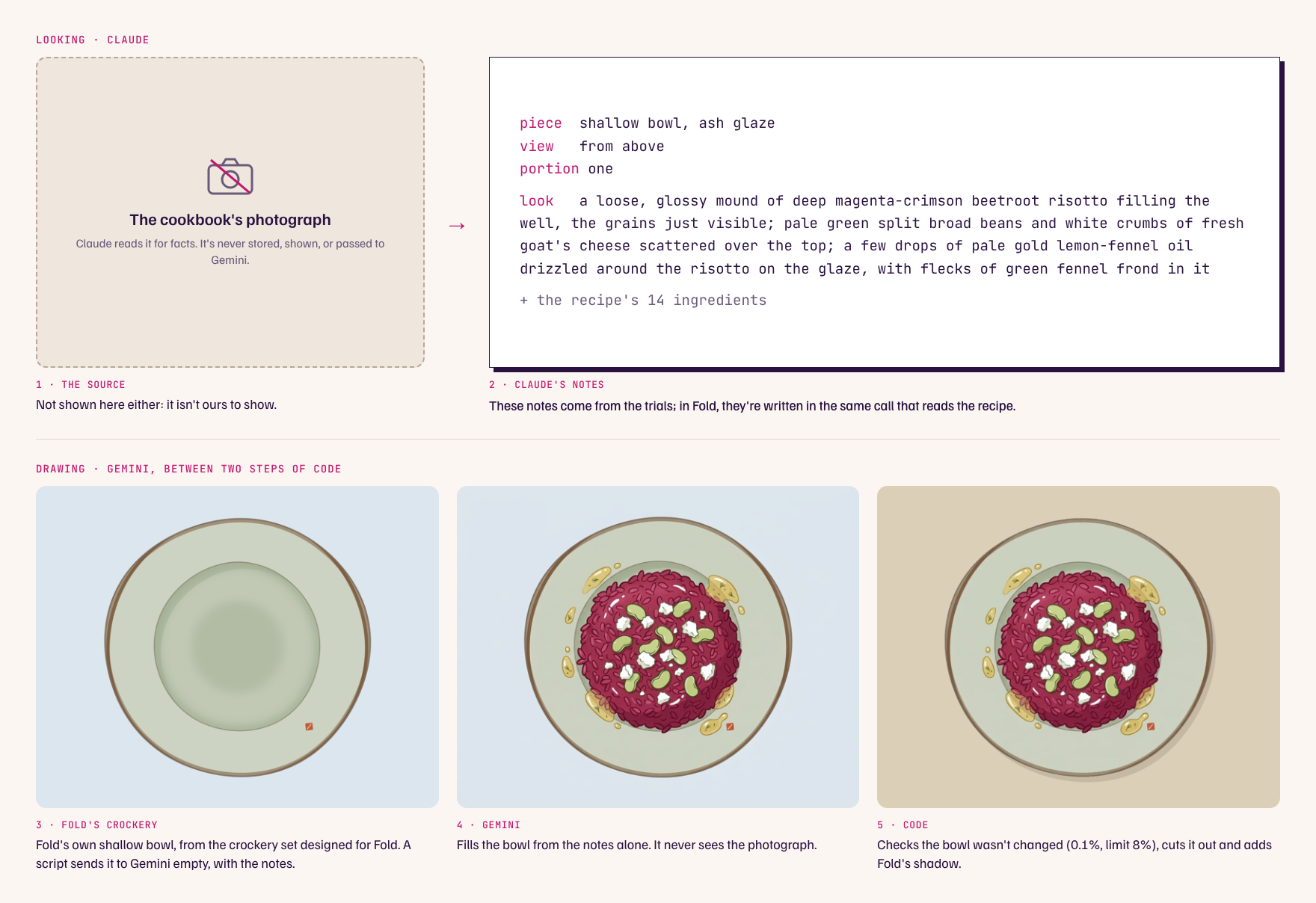
Fold separates the act of looking at the recipe photo from drawing it. When Claude reads a recipe that comes with the book's photograph of the finished dish, it looks at the photograph too and writes a short set of notes, a "look": which piece of crockery the dish belongs on, which view, the portion, and a plain description of what's on the plate, its colours and where things sit. The notes combine what the photograph shows with what the recipe says, in the same call that reads the recipe, so it costs nothing extra. The photograph is read for facts only and never stored, shown or passed on. Many of Fold's recipes had no photograph to read, either because the book didn't have one or because I chose not to upload it, so their notes are written from the recipe alone, which still gives the drawing a description to follow rather than a bare list of ingredients; I tested the photograph step on recipes that did have one.
Gemini then draws an original picture from those notes alone, and never sees the photograph. A script gives it the empty piece of crockery on a flat background and asks it to fill it, along with four approved example drawings sent every time so the 300th looks like the first. Editing an empty piece rather than generating a whole image is what keeps the crockery ours: in trials the piece came back unchanged to within a pixel or two. Code then cuts the drawing out and adds Fold's own shadow. The run shown above, which drew from risotto notes written during the trials, took 18 seconds, with 0.1% of the bowl changed against a limit of 8%.
The result is stylised but true to the dish: recognisably the beetroot risotto with its broad beans and goat's cheese, not a generic red rice. I also feel this approach is more honest than a photograph would be. A photoreal image promises a result no home kitchen may end up achieving, whereas a drawing says "roughly this", which is true of anything cooked at home. The test I used was whether a family member could name the dish at the size it appears on a card (about 280 pixels wide).
Making it look like Fold
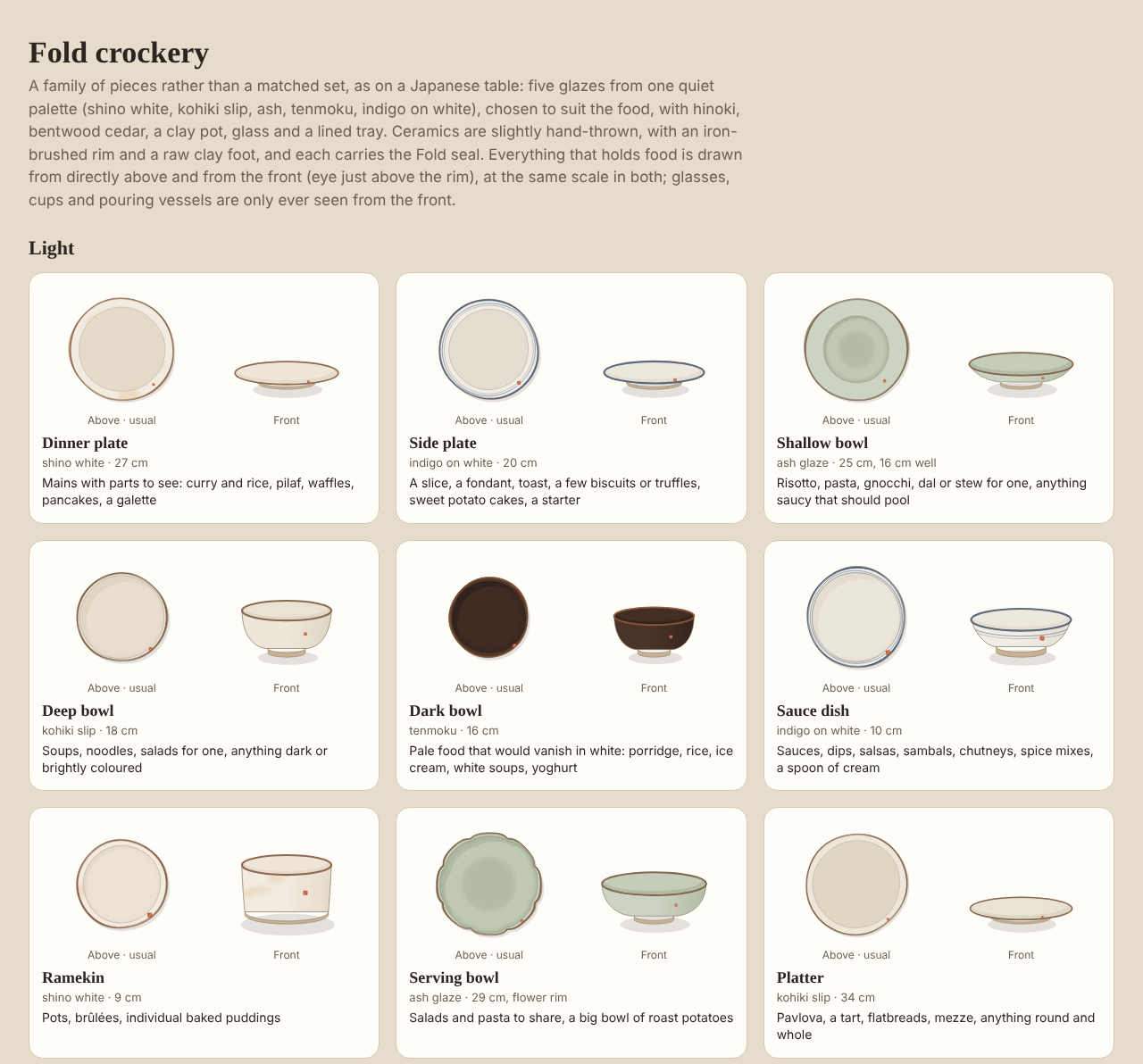
The next issue was that the pictures also had to belong to the product and have the right look and feel. Fold's design borrows from origami, so I chose a subtly Japanese house style for the drawings, in grammar rather than motifs: flat colour and a clean line like a print, and a table set from a family of hand-made pieces rather than a matched set. I didn't want to go OTT, so there's no cherry blossom, waves or chopsticks. A serving of dhal on Fold's table shouldn't make the dhal Japanese.
Fold therefore has its own crockery, in five glazes that each have a job. Pale food goes in the dark tenmoku bowl so it doesn't vanish; red and orange food goes on the pale green ash glaze; never green food on green. Each ceramic piece, the clay pot and the board carry a small vermilion seal, deliberately more orange than the app's red so it can never be mistaken for an allergy warning. A script draws the crockery at the same scale, with the pieces that hold food drawn from above as well as from the front. The rule is that the model never invents crockery: if a dish fits nothing, that's a reason to add a piece, not to improvise one.
Choosing the model
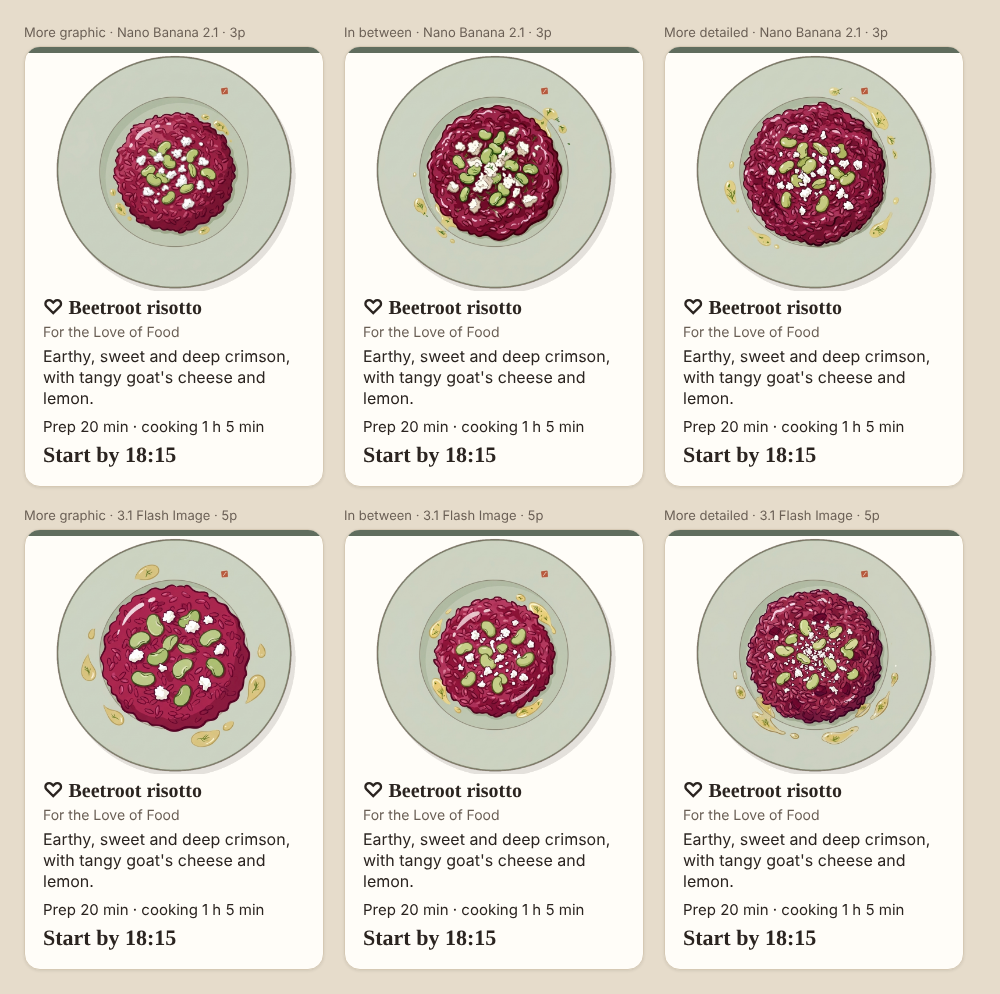
The Anthropic API doesn't generate images, so the drawing had to come from elsewhere. I tested two Gemini image models head to head, Nano Banana 2.1 and Gemini 3.1 Flash Image, each drawing the same risotto at three levels of detail: six drawings for about 30p. Nano Banana 2.1 at the in-between level gave the best balance of cost and quality, at about half the price per image ($0.034 against $0.067, half again in batches, as of October 2026). It's now the only image model Fold uses, for dishes, technique steps, equipment and the kitchen. Every image carries Google's SynthID watermark, which feels right for a product that's open about its drawings being generated.
Claude also tried a stronger woodblock version, which lost: the model can't carve a line that swells and tapers, and pushing for it cost the recognition the pictures are for.
What went wrong first
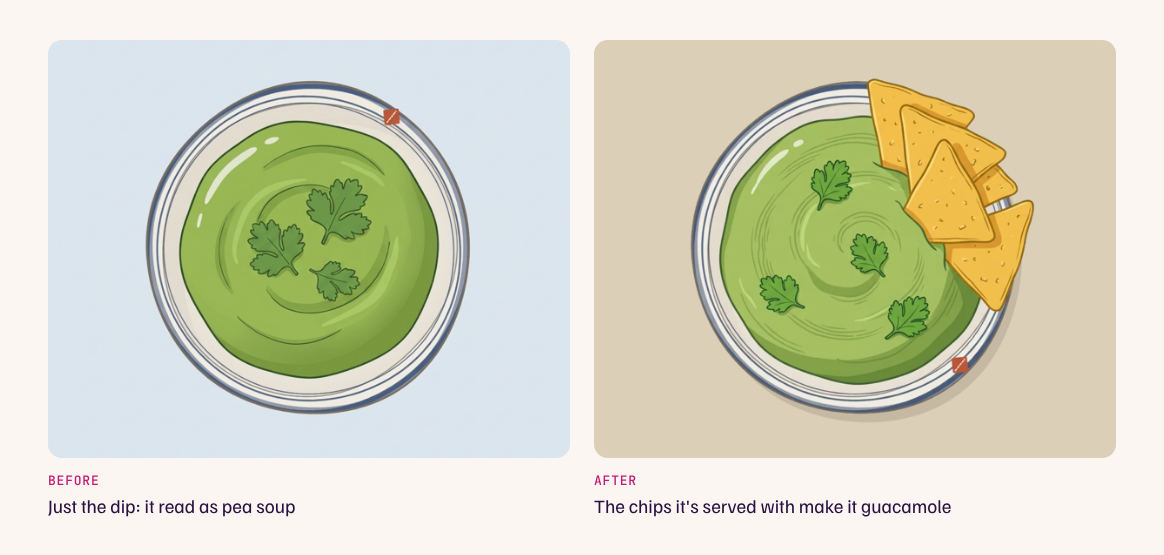
- Guacamole on its own read as pea soup. Claude spotted it when reviewing the ten trial drawings, and it became a rule for every dish: include the accompaniment that defines it. Masala chai went the other way: it's a mug of something milky, and the title does the work.
- The first quality check compared the rim pixel by pixel and couldn't tell a good drawing from a bad one, because a few pixels of drift made thin lines disagree everywhere.
- The model kept adding highlights and reflections to the crockery, hence a rule against them.
- Transparent backgrounds weren't supported, so it became a flat background with Fold's own cut-out and shadow.
- The backfill finished, then the downloader crashed reading a results file over 512 MB into memory.
The same idea, twice more
Know-how.
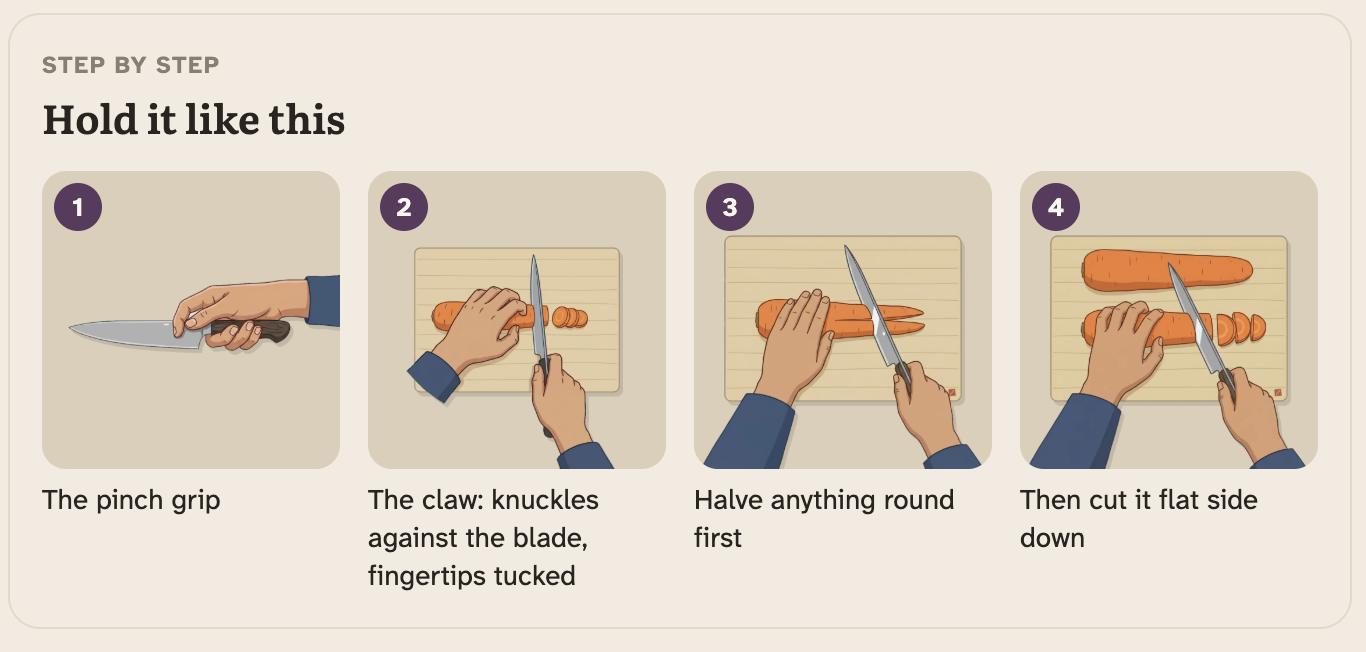
Fold allows users to upload techniques pages as well as recipes, and these populate the Know-How page. I wanted every technique page to have visuals, and many of the books show steps as photographs I couldn't use. Claude first drew everything in code, hands included, through several rounds of fixes. The hands were truly terrible, so I tried Nano Banana instead. A trial of 24 frames got 17 right: the same hands and indigo cuffs held across every frame, and shaping a loaf read well step by step because each frame was drawn from the one before. The failures were telling: in the claw grip both hands ended up on the knife, a tart tin shrank into a corner, and the onion's lengthways cuts weren't drawn at all, because the lines the model drew were the onion's natural layers.
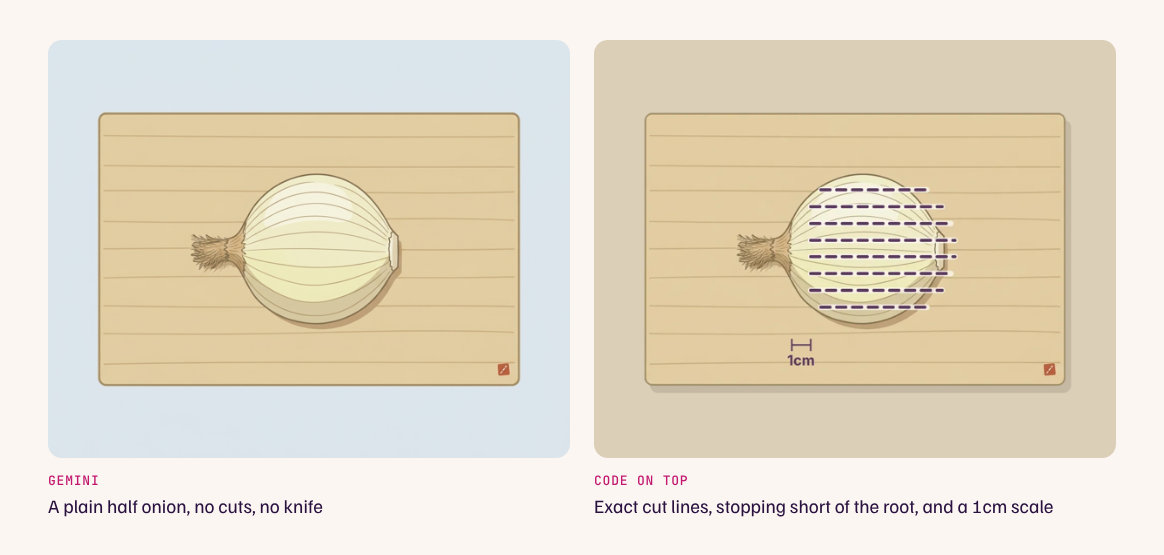
Again the answer was to split the tasks between models: Gemini draws a plain, uncut half onion; Claude measures where the onion and its root are and lays exact dashed cut lines over it, stopping short of the root, with a 1cm scale. Diagrams drawn entirely in Claude stay for exact geometry: cut sizes to scale, the plait, temperature scales. Steps raised problems dishes never had: one consistent pair of hands, frames that read as a sequence, kit to draw into (a glass bowl and a steel knife joined the crockery set), and an automated check that at first mistook hands in indigo sleeves for people. In all, 478 step frames across 80 techniques, plus 59 diagrams drawn in code.
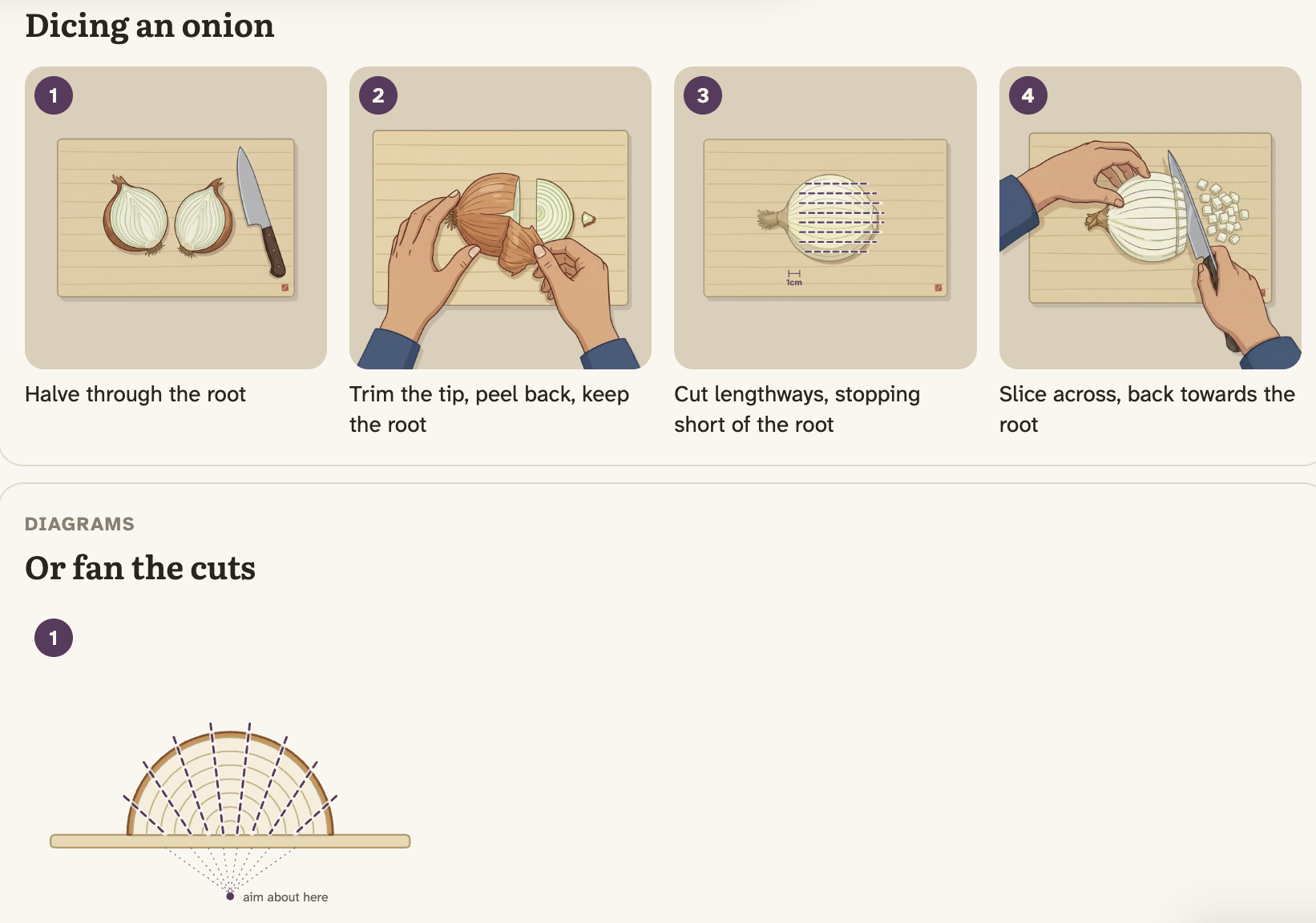
Where it still breaks: hands that look right but aren't. The method sorts things by whether they need to be exact, and a hand turned out to be harder to sort than it looks. How a hand holds a knife reads as appearance, so it went to the model, but a safe grip is really a matter of precision. In some of the knife frames the guiding hand lies flat with its fingers out near the blade rather than curled into the claw the caption describes. A cook glancing at them might not notice; someone learning knife skills might copy them. The automated checks didn't catch it either, because they were looking for the wrong things for a dish (meat, text, props), not for an unsafe technique, which is partly why I'm redoing the technique pages; the rest is that their layout needs work. In the redo, anything a cook might copy for safety gets treated as precision, with the grip specified exactly and checked, rather than left to "roughly this".
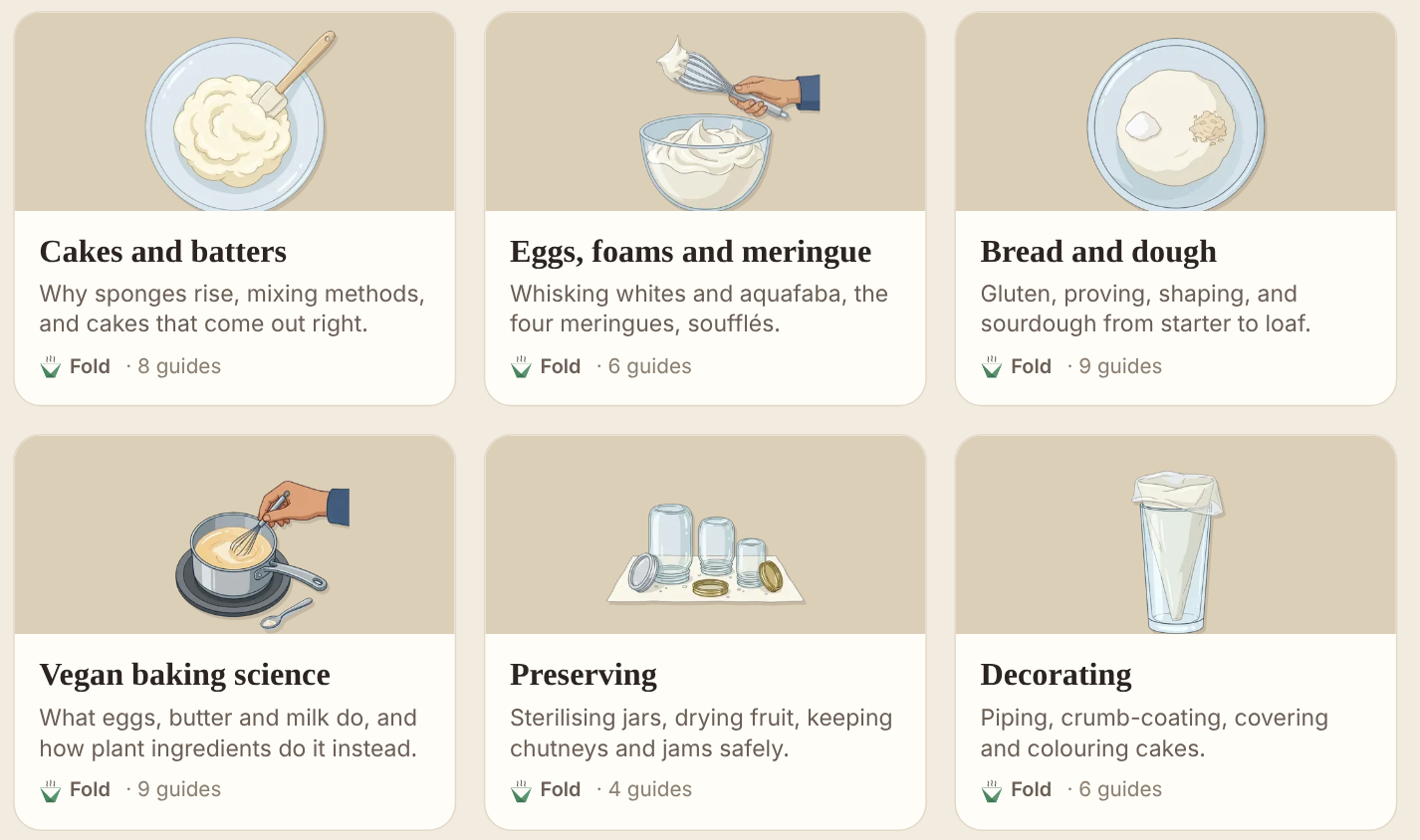
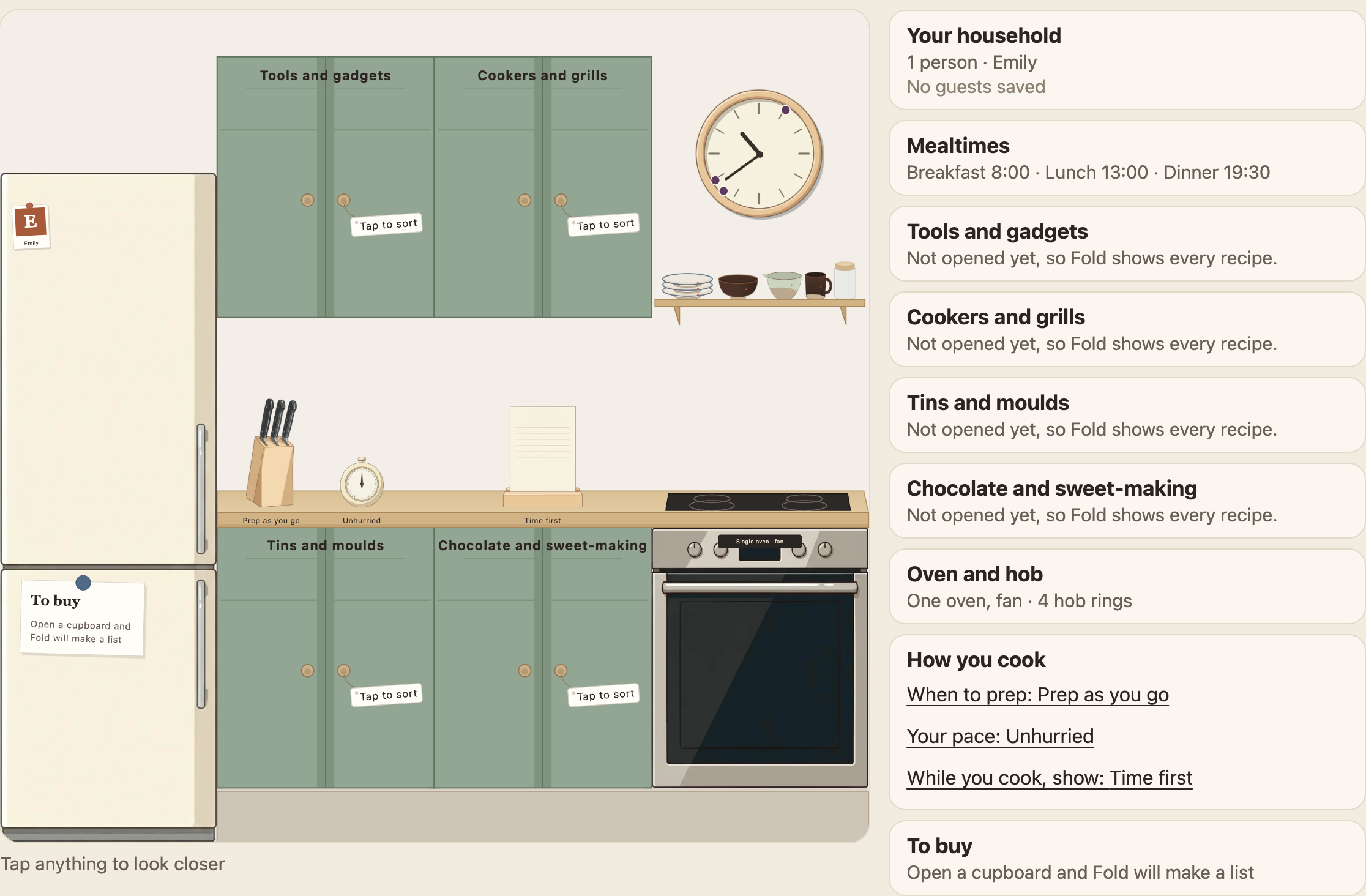
Your kitchen. Fold has a picture of your kitchen where you put away the equipment you own. I asked for drawings of each piece of kit rather than text labels, but found the first hand-built kitchen looked like something done in Microsoft Paint c. the 1990s. The rebuilt one uses the same split a third time: Gemini draws whatever should look made by hand (the fridge, ovens, clock, knife block, timer), and Claude codes whatever has to line up (cupboards, sliding doors, the worktop, shelves). The clock's hands and the timer's pointer are left blank in the drawing so code can draw them.
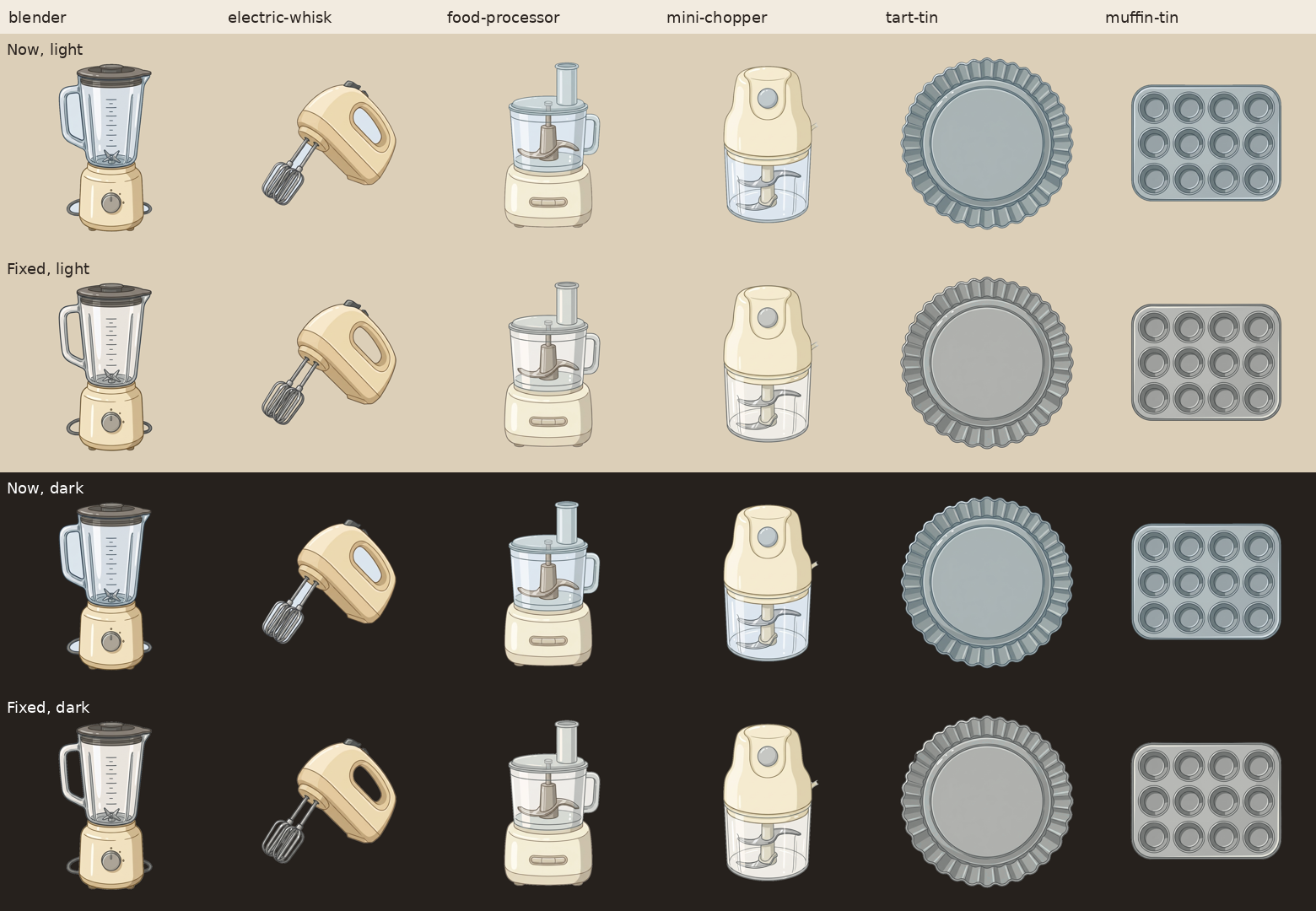
New problems arose that needed encoding: avoiding the shapes of well-known brands, each piece at its true proportions, and the pale blue background tinting steel and glass, which needed its own fix.
The method
All three times, the problems ended up having the same answer: Gemini draws what should look made by hand; Claude codes what has to be exact, line up or move. The crockery, the cut lines and the cupboards are coded; the food, the hands and the fridge are the model. It works because each does only what it's good at: the model is good at plausible and bad at precise, and code is the reverse.
What it cost
Before each batch of drawing, Fold’s design notes estimated under £10 to draw the whole back catalogue with redraws, about £6 for the technique frames and about £2 for the equipment. The real Gemini bill for October came to £32.67, most of it on a single day. The difference is the work an estimate per image doesn’t see: trials, model comparisons, redraws of drawings I didn’t like, and tuning the checks. It's obviously expensive, but this was primarily an experiment and learning exercise. Going forwards, however, each new recipe now costs a few pence. Fold’s full costs, measured and estimated →
Who did what
- I framed: the photograph problem and the answer to it (notes from the photograph, drawing from the notes); the standard that pictures must resemble the dish; the subtly Japanese house style; visuals for every technique; drawings of kit instead of labels.
- I set up the team: Claude reads recipes, writes the notes and checks the drawings; Gemini only draws; code draws everything exact; four example drawings hold the style, Claude's idea, chosen by me.
- I decided: Nano Banana 2.1 after the trial; Nano Banana instead of code-drawn hands; sent back the "Microsoft Paint" kitchen and the dashed outlines for missing kit.
- Claude built: the edit-an-empty-piece method, the woodblock trial, the crockery script, the guacamole diagnosis and accompaniment rule, the base-plus-overlay split, the kitchen split.
Outside the lab
Organisations adopting image generation tend to ask which model looks best. Based on my experience with this project, the more useful questions might be which parts of a picture must be exact and which may only be plausible; whether a generated image claims more than is true (a photo-real "result" for something nobody has made); whether the source material's rights have been respected by design rather than by luck; and whether the brand lives in a prompt that drifts or in components that can't. In health and care, where pictures in patient materials carry the same risk of over-promising, I'd want those answered before choosing a model.